The Power of APIs in Modern Web Development
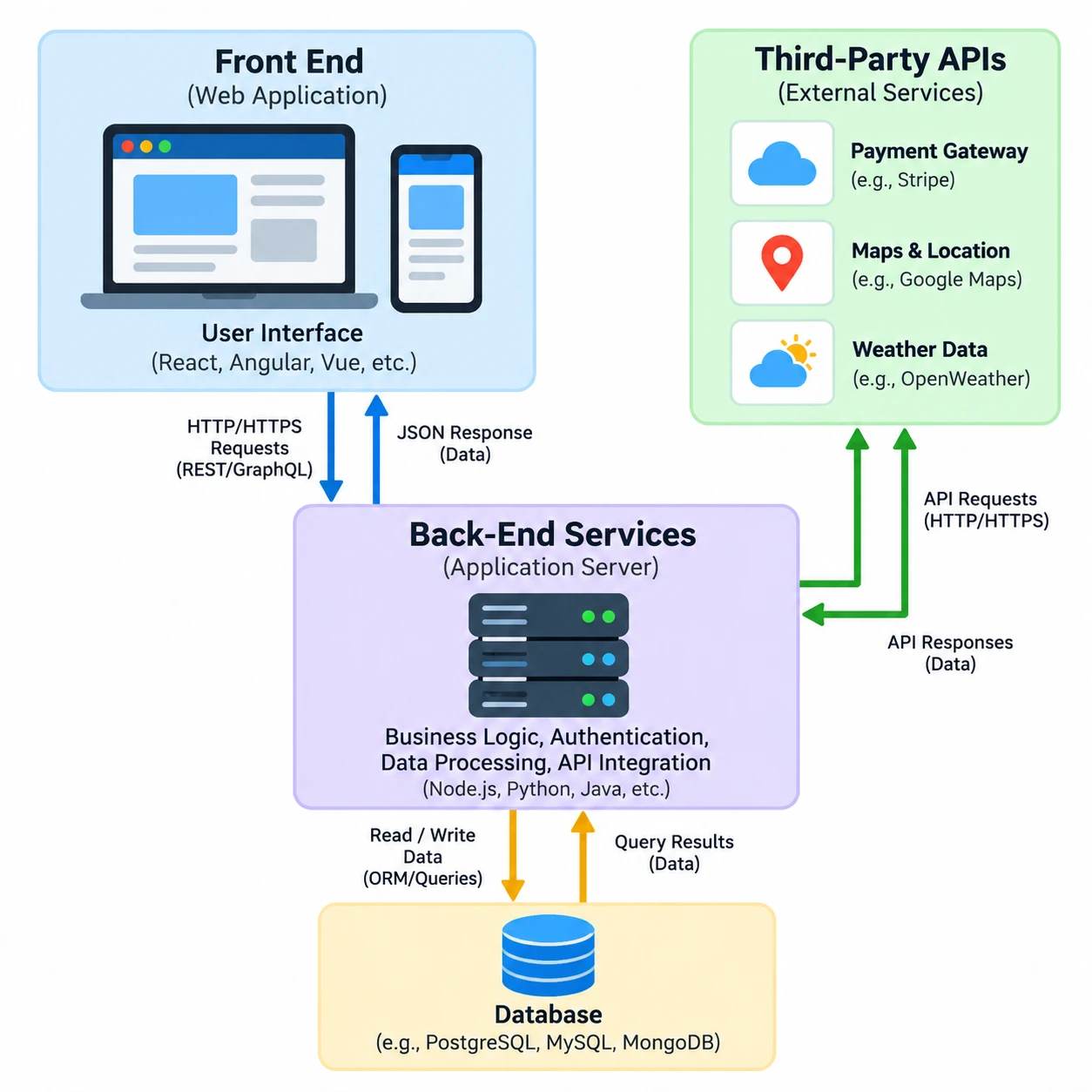
Modern web applications rarely work alone. A booking site may need to check live availability, process payments, send confirmations, and show maps, all while giving users a smooth experience. APIs make these connections possible, letting separate software systems exchange requests and data through agreed rules.
For businesses, a well-planned API strategy can make an application easier to extend and integrate. The value depends on choosing suitable interfaces, protecting sensitive information, and maintaining connections as systems change.
What Is an API and How Does It Work?
An Application Programming Interface (API) is a defined way for software systems to request and exchange information or actions. It sets the rules for what one application can ask another to do and how the response will be returned.
Think of an online store. Its front end displays products and accepts a customer’s choices. When a shopper checks out, the web application may send a request to a back-end service to confirm stock or calculate shipping. The back end processes the request and returns data, which the front end can present to the user.
An API works like a contract between the systems: it describes available operations, required inputs, and the shape of a response. A request might ask for a product by its ID; the response could include its name, price, and availability. The systems do not need to share the same programming language or internal structure, provided they follow the API’s rules.
APIs can connect parts of one product, such as a front end and back end, or link a web application to third-party services. They are often used through web protocols, but the term API covers more than web-based interfaces. A web service is one kind of system that makes functionality available over a network; an API is the broader interface that defines how software interacts.
Why APIs Matter in Modern Web Development
APIs matter because they connect the front end, back end, and external services without requiring each part to be built as one tightly bound system. That separation helps teams deliver useful features and adapt applications as business needs evolve.
A front end can request information from a back-end API and display it in a browser, mobile app, or other interface. The back end can handle business rules, data storage, and permissions. Meanwhile, API integration can bring in capabilities such as payment processing, address validation, analytics, or customer relationship management.
This arrangement gives teams room to change one layer while keeping others stable, as long as the API contract remains compatible. For example, an organization could redesign its website while keeping the same back-end services and customer records. The trade-off is that separate components need clear ownership and monitoring; an API connection adds a dependency that can fail or change.
APIs also support connected experiences across channels. A customer might begin an order on a desktop site and check its status in a mobile app. Both interfaces can use the same underlying services, rather than maintaining separate versions of core business logic. This can improve consistency, though it requires careful decisions about data access and user identity.
Common API Types and Approaches
REST and GraphQL are two common approaches for web APIs, and neither is right for every project. The best fit depends on the data, client needs, team experience, and operational requirements.
REST APIs
A REST API typically organizes data around resources, such as users, products, or orders, and uses standard HTTP methods to work with them. It is widely understood and can be straightforward to document, cache, and integrate with many tools. Its familiar structure makes REST a practical choice for many web applications.
However, a REST endpoint may return more fields than a particular screen needs, or require several requests to assemble a view. Teams can address those patterns with thoughtful endpoint design, but the API should reflect real use cases rather than simply mirror a database schema.
GraphQL
GraphQL lets a client request specific fields, often combining related data in one query. This can suit applications with varied interfaces, where different screens need different selections of the same data. It also gives clients flexibility as they develop new views.
That flexibility comes with design and operational considerations. Teams need to manage query complexity, permissions at the field level, and caching strategies. GraphQL can be unnecessary overhead for a small application with simple data needs. The choice should follow the shape of the product, not a preference for the newest approach.
Key Benefits of API-Driven Development
API-driven development makes it easier to connect capabilities, reuse services, and evolve application components independently. These benefits can support scalable web applications, provided teams plan for integration and maintenance from the start.
- Integration: APIs connect a web application with payment gateways, identity providers, shipping platforms, and other third-party services. A planned integration should account for credentials, error responses, rate limits, and service outages.
- Reusable functionality: A shared service can support multiple front ends or internal tools. For instance, the same catalog API might serve a storefront and a staff inventory screen, with access controlled for each user type.
- Flexibility: Separate interfaces and services can be updated on different schedules when their contracts are managed carefully. This can make a redesign or new channel easier to deliver.
- Scalability: APIs create boundaries between parts of a system, making it possible to scale or replace components where needed. They do not guarantee scalability by themselves; database design, traffic patterns, infrastructure, and monitoring still matter.
A useful planning exercise is to map each integration by its purpose, owner, data exchanged, and failure impact. A payment connection deserves a different fallback plan from an optional recommendation widget. This simple inventory helps teams prioritize testing and decide which services need retry logic, alerts, or a manual alternative.
API Security and Design Considerations
Secure API design combines controlled access, careful data handling, clear documentation, and compatibility planning. Authentication confirms who or what is making a request; authorization determines what that requester is allowed to do.
For example, a signed-in customer may be authenticated but should only be authorized to view their own orders. An API should enforce that rule on the server, rather than relying on the front end to hide other records. Teams should also use encrypted connections, store secrets outside public code, validate inputs, and avoid returning data that a client does not need.
Good design supports security and maintainability at the same time. Document expected inputs, responses, error cases, and rate limits so developers can use the API consistently. Versioning can help when a breaking change is unavoidable, but introducing a new version also means supporting migrations and potentially maintaining old clients for a period.
Common mistakes include:
- Trusting the interface to enforce permissions. This happens when a hidden button is mistaken for access control. The result can be unauthorized data access; enforce permissions for every protected operation on the server.
- Returning excessive data. It may seem convenient to send an entire record, but unnecessary fields can expose sensitive information and increase processing. Return only what the client needs.
- Ignoring failure behavior. External services can time out, reject requests, or change limits. Define useful error responses, set sensible timeouts, and test fallback behavior before launch.
- Changing contracts without a migration plan. A quick update can break web or mobile clients still using the old format. Document changes, check client usage, and communicate a deprecation timeline.
Building API Integrations with a Web Development Partner
A web development services provider can help plan, build, test, and maintain API-connected solutions, especially when several systems or teams are involved. The goal is to make integrations fit the product and its operating needs, not merely to get data moving.
A sound project usually begins with discovery: which systems need to communicate, what data should move, who owns each service, and what happens if a connection is unavailable? The team can then compare REST, GraphQL, or a provider’s existing interface against the application’s actual requirements. Security and privacy expectations should shape the design from the outset.
During implementation, developers can build the API layer, configure authentication and authorization, and test both normal and failure scenarios. Testing should include invalid inputs, expired credentials, slow responses, and changes in third-party behavior. Documentation and monitoring matter after launch as much as the initial integration; APIs need updates, alerting, and clear ownership.
When evaluating a partner, ask how they handle API contracts, versioning, access controls, testing, and ongoing support. A focused integration may be simple to maintain, while a network of critical services can require more extensive monitoring and operational planning. Being clear about those needs early helps the project team make practical decisions about scope and long-term responsibility.